Blockchain in Zig
A blockchain is a sequence of data blocks. The integrity of an individual
data Block is established by signing it with a hash. The integrity of
the complete sequence of blocks is established by ensuring the hash of
each Block includes the hash of the previous block.
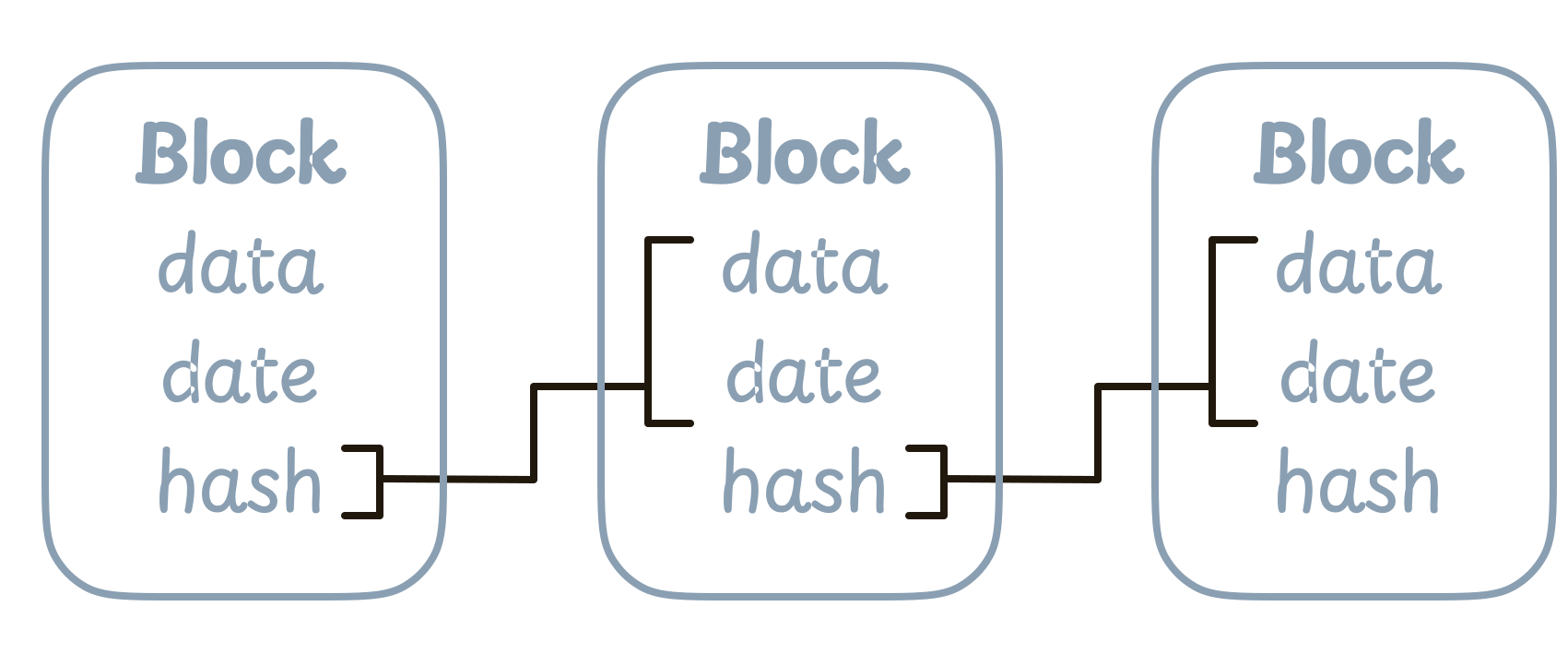
Each block is signed by hashing its contents along with the hash from the previous block.
Consider this simple Block:
pub const Block = struct {
    pub const hash_length = 32;

    data: []const u8,
    when: i96,
    hash: [hash_length]u8,
}
Zig convention is to avoid defining magic numbers as global or top level
variabes, the Block hash_length is declared inside the Block struct.
Bitcoin is signed with sha256 and Ethereum is signed with a slightly more
modern and secure1 keccak256:
fn calculateHash(
    data: []const u8,
    now: i96,
    previous_hash: []const u8,
) [hash_length]u8 {
    //var h = std.crypto.hash.sha2.Sha256.init(.{});
    var h = std.crypto.hash.sha3.Keccak256.init(.{});
    h.update(previous_hash); // Add previous hash to the hash
    h.update(data);          // Add `data` to the hash
    var buffer: [@bitSizeOf(i96) / @bitSizeOf(u8)]u8 = undefined;
    std.mem.writeInt(i96, &buffer, now, .little);
    h.update(&buffer);       // Add `now` timestamp to the hash
    return h.finalResult();
}
A basic Blockchain holds an array collection of Block entries, and
provides a way to append new blocks to the chain.
In zig, the Block struct would commonly be nested in the Blockchain
struct so that it nested into the Blockchain namespace.
pub const Blockchain = struct {

    pub const Block = struct { ... };

    blocks: std.ArrayList(Block) = .empty,

    pub fn append(
        self: *Blockchain,
        allocator: Allocator,
        io: std.Io,
        data: []const u8,
    ) Allocator.Error!void {
        const now = std.Io.Clock.now(.real, io).toNanoseconds();
        if (self.blocks.lastPtr()) |block| {
            try self.blocks.append(allocator, .{
                .data = try allocator.dupe(u8, data),
                .when = now,
                .hash = calculateHash(data, now, previous_hash),
            });
        } else {
            const zero: [Block.hash_length]u8 = @splat(0);
            try self.blocks.append(allocator, .{
                .data = try allocator.dupe(u8, data),
                .when = now,
                .hash = calculateHash(data, now, &zero),
            });
        }
    }
};
The append function does not simply hash the data and the when timestamp.
It includes the hash of the previous block, or a zero filled hash for the
first block.
Tying it all together, with appropriate init and deinit functions,
here is a complete working example of a minimal Blockchain in zig:
pub const Blockchain = struct {
    blocks: std.ArrayList(Block),

    pub const empty: Blockchain = .{
        .blocks = .empty,
    };

    pub fn deinit(self: *Blockchain, allocator: Allocator) void {
        for (self.blocks.items) |*block| {
            block.deinit(allocator);
        }
        self.blocks.deinit(allocator);
        self.* = undefined;
    }

    /// A block contains both an aribrary `data` byte sequence,
    /// and the `previous_hash` of the previous block.
    pub const Block = struct {
        pub const hash_length = 32;
        pub const zero: [hash_length]u8 = @splat(0);

        data: []const u8,
        when: i96,
        hash: [hash_length]u8,

        pub fn init(
            allocator: std.mem.Allocator,
            io: std.Io,
            data: []const u8,
            previous_hash: ?*const [hash_length]u8,
        ) Allocator.Error!Block {
            const now = std.Io.Clock.now(.real, io).toNanoseconds();
            return .{
                .data = try allocator.dupe(u8, data),
                .when = now,
                .hash = calculateHash(data, now, previous_hash orelse &zero),
            };
        }

        pub fn deinit(self: *Block, allocator: Allocator) void {
            allocator.free(self.data);
            self.* = undefined;
        }

        fn calculateHash(
            data: []const u8,
            now: i96,
            previous_hash: []const u8,
        ) [hash_length]u8 {
            var h = std.crypto.hash.sha3.Keccak256.init(.{});
            //var h = std.crypto.hash.sha2.Sha256.init(.{});
            h.update(data);
            var buffer: [@bitSizeOf(i96) / @bitSizeOf(u8)]u8 = undefined;
            std.mem.writeInt(i96, &buffer, now, .little);
            h.update(&buffer);
            h.update(previous_hash);
            return h.finalResult();
        }
    };

    pub fn append(
        self: *Blockchain,
        allocator: Allocator,
        io: std.Io,
        data: []const u8,
    ) Allocator.Error!void {
        if (self.blocks.lastPtr()) |block| {
            try self.blocks.append(allocator, try .init(allocator, io, data, &block.hash));
        } else {
            try self.blocks.append(allocator, try .init(allocator, io, data, null));
        }
    }
};
Finally, we need a validate function to check the contents of
the Blockchain. This is achieved by starting at the first block, and
recalculating the hash of each block:
pub fn validate(self: *Blockchain) bool {
    var previous: ?*Block = null;
    for (self.blocks.items) |*block| {
        const hash = Block.calculateHash(
            block.data,
            block.when,
            if (previous) |p| &p.hash else &Block.zero,
        );
        if (!std.mem.eql(u8, &hash, &block.hash)) return false;
        previous = block;
    }
    return true;
}
Added — November 2026
A complete working zig example, including addtional blockchain load
and save example functions
is available on github.